
Sex Offender Checks in Cameron County
The Texas Public Sex Offender Registry is the main public source for a Cameron County sex offender search. Texas DPS manages the database, and no account or fee is needed for a public query. Searchers may look by a registrant's name, a street address, ZIP code, county, or higher-education campus. The map and list views work together. Neither should be treated as a fingerprint-confirmed identity match.
Start with the fact that best fits the safety question. A county filter gives a broad Cameron County registry list, while an address search focuses on a home, school route, or nearby block. A name search needs first and last names, with birth date as an optional check. DPS says fingerprints are the only positive means of identification. Compare the photo, physical description, birth date, offense details, and verification agency before concluding that a result refers to a particular person.
The DPS registry FAQ explains the limits of public searches. The screen below reflects those state rules rather than a separate Cameron County database.
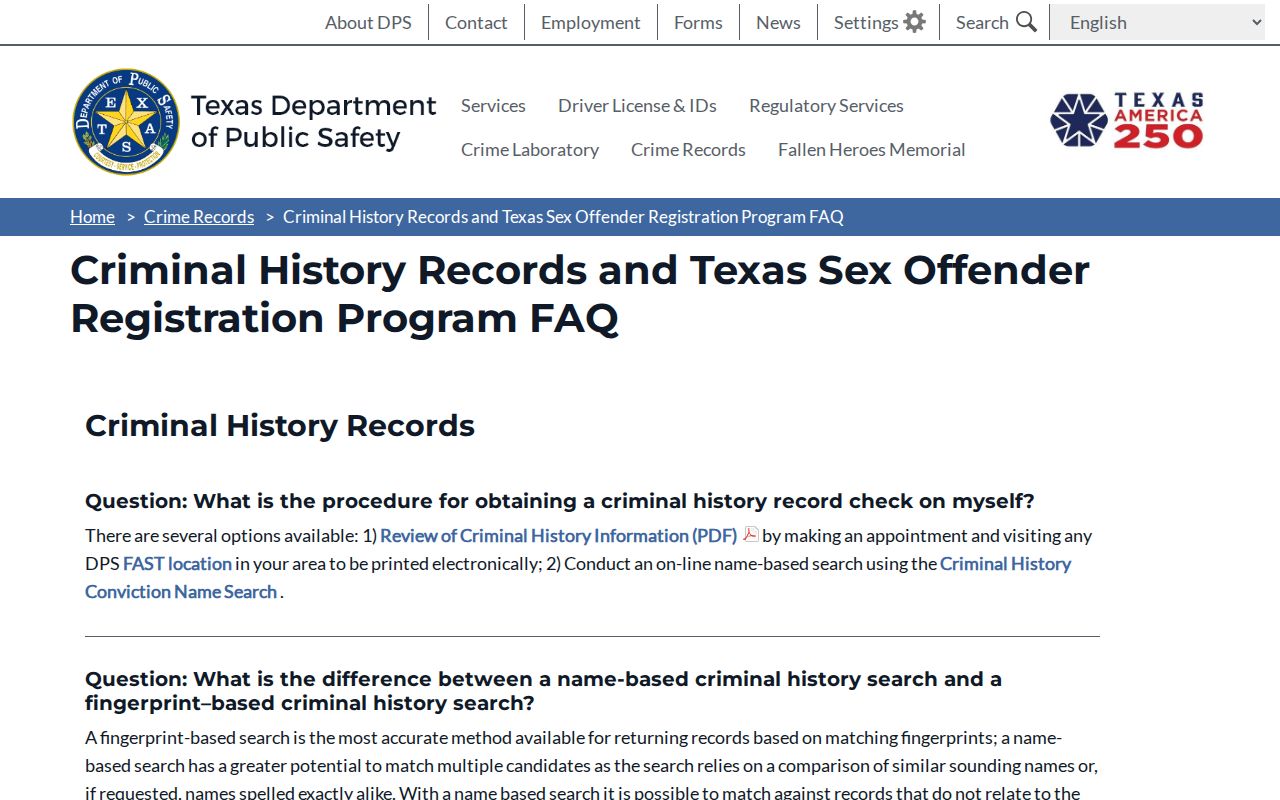
The FAQ is useful when a search yields no result, an address looks stale, or a public field differs from a complete registration record.
Cameron County Registry Code 031
The county control narrows the Texas list to Cameron, whose registry code is 031. That option helps when a street is unknown or when a family wants countywide context. It does not replace a name or address check. Someone may have moved, may register through a city police department, or may appear in the unmapped result group even though the record belongs within Cameron County.
A county query should therefore be paired with the map and unmapped list. DPS warns that mapping software cannot place every address. Rural descriptions, new roads, incomplete coordinates, and location descriptions can all keep a valid Cameron County registration off the visible pins. Treat the plotted map as one view of the underlying records, not as the whole registry.
How to Search the Texas Public Sex Offender Registry
The state search form offers several paths, each built for a different fact pattern. The clearest Cameron County sex offender search begins with a narrow, known identifier and then expands only if needed.
- Open the official Texas DPS public registry and review its conditions and identity warning.
- Select registrant name, address, ZIP, county, map address, or higher-education search. Use Cameron County code 031 for the county option.
- Compare mapped, listed, and unmapped results. Use the available photo and profile facts to rule out weak name matches.
- Open the relevant profile and contact its listed verification agency if an address, status, or identity fact needs confirmation.
The Texas registry search interface shown here includes location and identity routes on one official screen.
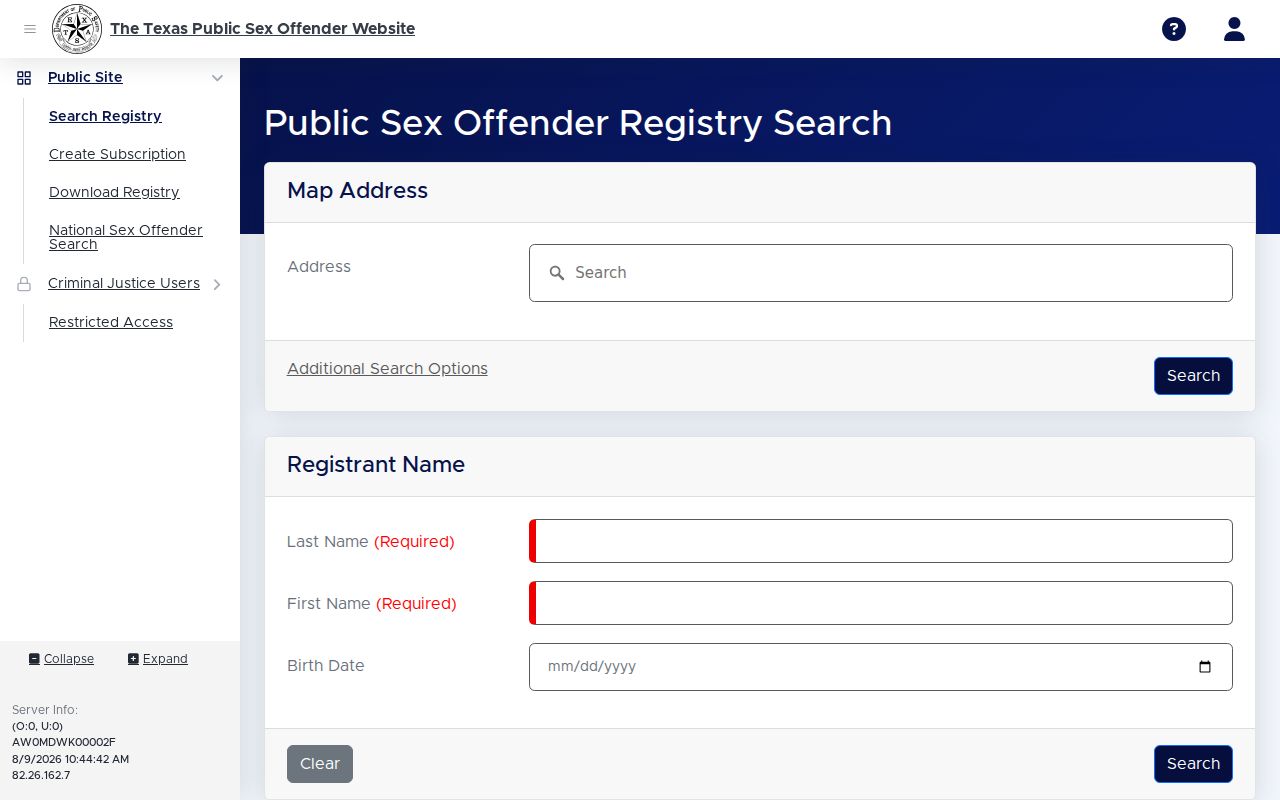
Its distinct tabs keep a name query separate from a Cameron County, address, ZIP, map, or campus query.
| Search channel | Fields | Required | Cameron County use |
|---|---|---|---|
| Map Address | Address autocomplete | A Texas location | Creates a mapped point from coordinates and place text |
| Registrant Name | Last name, first name, birth date | First and last; birth date optional | Best when identity facts are known |
| Address Detail | Number, street, city, state, ZIP | All listed fields | Checks a full local street address |
| ZIP or County | ZIP field or county dropdown | One chosen area | Select Cameron, code 031, for countywide results |
| Higher Education | Institution and campus | Both fields | Includes Texas Southmost College and UTRGV |
Unmapped Cameron County Registrations
A blank spot on the map is not proof that no registrant is tied to the area. DPS puts records that its software cannot geocode into an “Unmapped” category. A Cameron County registry review should open that category after checking map pins and list results. This is one of the most important safeguards against a false sense of completeness.
If an expected address will not map, retry the structured address fields and search the city or ZIP. Then filter by Cameron County. When a likely profile appears, the verification agency listed in that record is the proper source for correction or current address confirmation. DPS accepts registry questions at 512-424-2800 and SOR.Training@dps.texas.gov, but local address facts are verified by the local registration authority.
Note: A missing map pin can reflect geocoding limits, not the absence of a Cameron County registration.
Inside a Registry Profile
A public profile is a limited safety record, not the full file collected by Texas. It can show facts needed to recognize a registrant and understand the duty that produced the listing. Other details stay confidential by law. Use the profile as a lead for verification, especially when names are common or an address seems out of date.
| Name and aliases | Public identity names connected to the registration record |
|---|---|
| Photo and description | Photo plus available sex, race, height, weight, eye, and hair details |
| Registered location | Residence address or a geographic-location description when allowed |
| Offense information | Qualifying offense, statute, conviction date, and related public case facts |
| Risk and duty | Texas numeric risk information, registration status, and verification agency |
| Withheld data | No Social Security number, driver-license number, phone, online identifier, employer detail, victim identity, or protected juvenile material |
The full registration record also gathers fingerprints, vehicle information, shoe size, release or supervision facts, and higher-education status when applicable. Public access is narrower. That gap is intentional, so a public Cameron County profile should never be described as a complete government file.
Cameron County Address Verification
Registration follows the place of residence. A person who lives within a Cameron County municipality generally registers with that city's police department. A person living outside a municipality registers with the Cameron County Sheriff. There is no single county counter that handles every registrant. The correct office depends on the actual residence, not merely the Cameron County label in a state search.
Verification timing also varies. Most registrants verify once a year within the window around their birthday. A person with two or more qualifying sexually violent convictions or deferred adjudications must verify at least every 90 days. Certain civilly committed persons report more often. Texas also generally requires in-person notice before a move and notice to the new authority after arrival under the seven-day rules.
The Texas DPS registration program overview places those local duties in the statewide system.
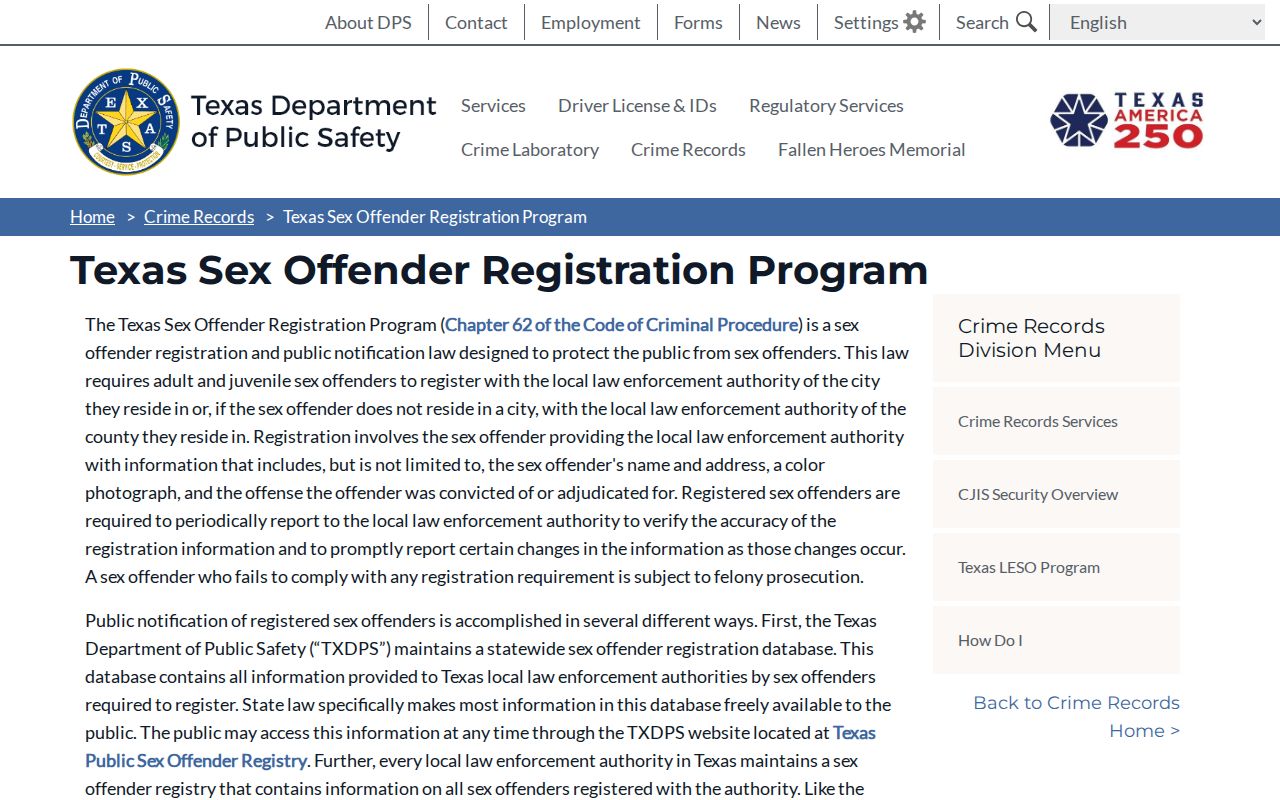
This state program is the source for registration guidance, while the named local police department or sheriff verifies a Cameron County address.
Texas Registration Levels and Requirements
Texas does not label its public registry with federal SORNA tiers. Its numeric risk levels 1, 2, and 3 support state notification decisions, while the qualifying offense and Article 62.101 control registration duration. Calling risk level 1 “Tier I” would blur two different systems and could misstate the record.
| Texas concept | Duration or meaning | Typical verification |
|---|---|---|
| Numeric risk 1, 2, or 3 | State risk assessment used for notification, not a federal tier | Frequency comes from the person's statutory status |
| Lifetime registration | Applies to listed sexually violent and other offenses; generally ends at death absent relief | Usually annual; qualifying repeat matters at least every 90 days |
| Ten-year registration | Generally ends ten years after the controlling release, discharge, or dismissal event | Generally annual within the birthday window |
| Special rules | Juvenile, out-of-state, civil commitment, and early-termination matters require case-specific review | May be more frequent under the governing order or statute |
The Code of Criminal Procedure Chapter 62 sets the public-information, verification, move, and duration rules. A profile alone cannot resolve every duty or relief question because the offense, order, release event, and prior qualifying history all matter.
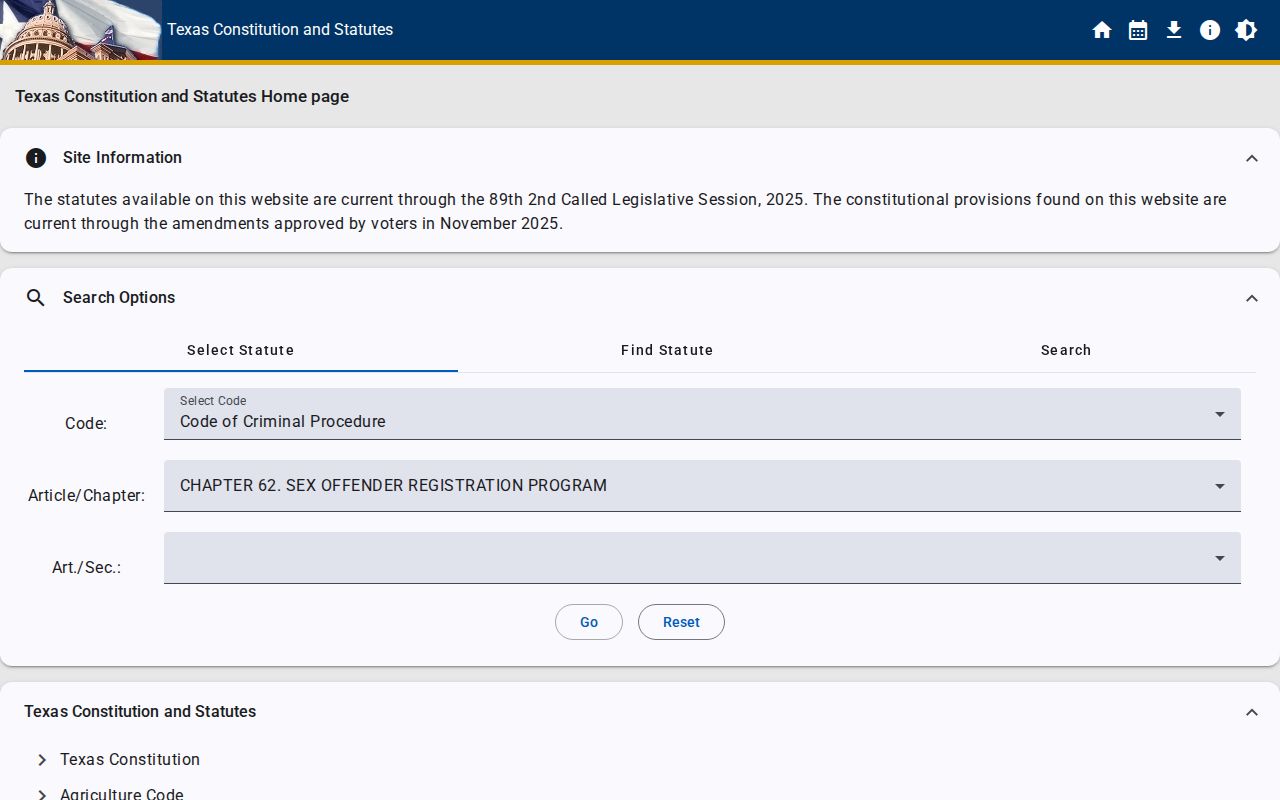
Chapter 62 is the controlling legal source behind a Cameron County registration period and the scope of public registry data.
Cameron County Address Subscriptions
A public registry account can support offender or address subscriptions. This lets a Cameron County resident follow a chosen address or listed record without repeating the same manual search each day. An alert is a prompt to open the current official profile, not proof that a person moved, violated a rule, or committed a new offense.
The official Texas DPS mobile application also advertises an interactive registry map with location, name, route, and proximity tools. The website remains the clearest primary channel because its search fields and warnings are public and citable. When using either channel, keep the same method: review mapped and unmapped results, compare identity facts, and confirm uncertain data with the verification agency.
Cameron County and NSOPW
The National Sex Offender Public Website adds a cross-state layer. It is useful when a Cameron County address search suggests ties outside Texas, or when a family route crosses state lines. NSOPW gathers public records from participating jurisdictions, while the Texas portal supplies the richer state search controls for county code, campus, ZIP, and unmapped entries.
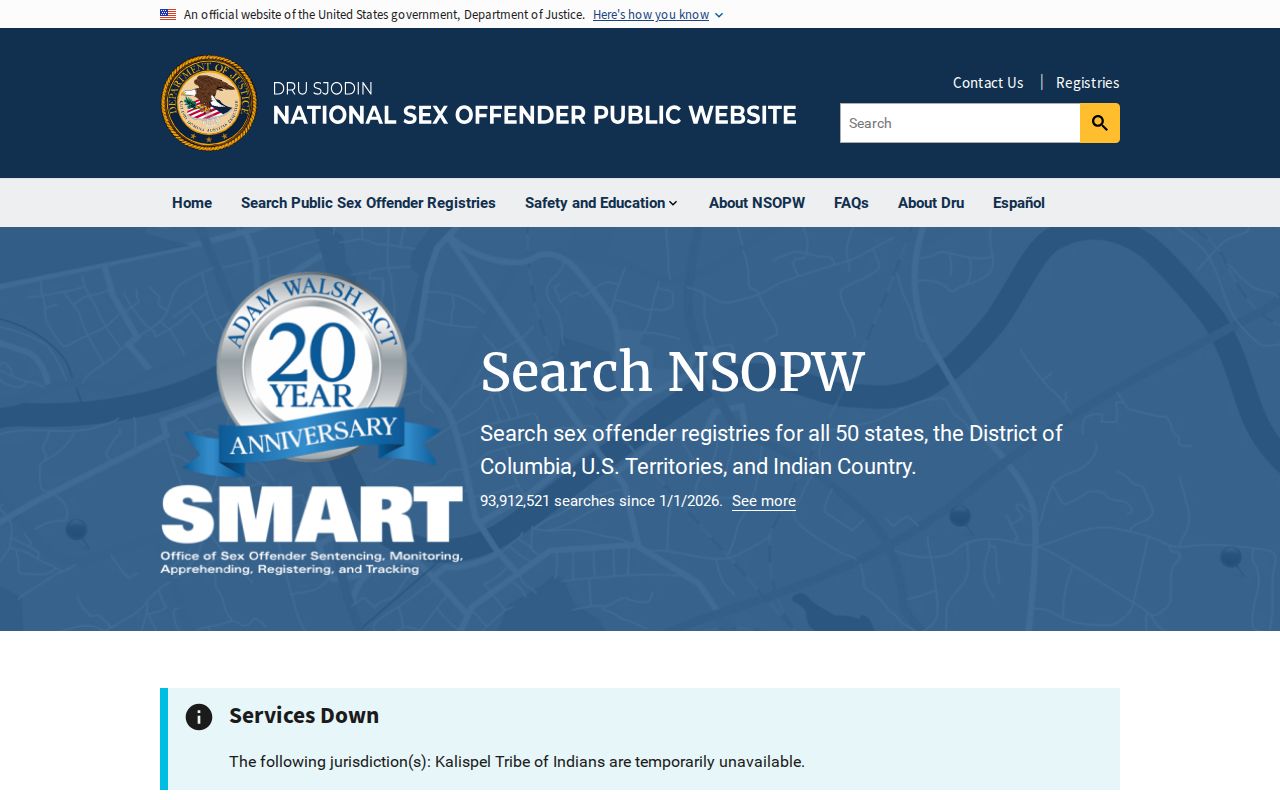
The national screen broadens geographic scope, but a Texas match should still be opened and checked in the DPS record and with its verification agency.
Use the two systems in sequence rather than treating them as competing answers. Begin with DPS for Cameron County detail. Add NSOPW when the search concerns travel, a prior out-of-state address, or a person whose possible records may cross jurisdiction lines. Neither search creates a complete identity history, and neither replaces fingerprints for positive identification.
Community Notification and Lawful Use
Registry information exists for public awareness and sound safety planning. A household may review nearby addresses, teach children how to seek help, or confirm which agency handles a listed address. Public access does not authorize confrontation, threats, injury, stalking, or the misuse of a registrant's household information. An apparent error should go to the profile's verification agency rather than being spread as fact.
Chapter 62 makes specified registration information public while protecting victim identities and other sensitive fields. It also warns that misuse can bring criminal prosecution or civil liability. Cameron County residents should preserve the profile URL and date when reporting a concern, state the exact field believed wrong, and allow the police department, sheriff, or DPS to review the official file.
Use registry data lawfully: Misusing Texas registry information to harass, threaten, injure, or commit another crime can lead to prosecution and civil liability under Code of Criminal Procedure Chapter 62.