
Checking Criminal History in Cameron County
Start with the record that answers the question. Cameron County District Clerk files cover district-court felonies. The County Clerk and Courts at Law handle Class A and B misdemeanors. A city municipal court holds fine-only Class C cases and city ordinance matters. For current custody, the official Cameron County jail roster is the first stop. The Texas Department of Public Safety, or DPS, provides the public statewide conviction and deferred-adjudication product. A fingerprint review is the stronger route for checking your own identity-based Texas history.
Have the full legal name, spelling variants, a likely date range, and the court or arresting agency if known. A date of birth can help separate common names, but public displays may mask it. Match a result by cause number, filing date, court, charge, and disposition. Cameron County criminal records should never be tied to a person by name alone.
- Choose the Cameron County custodian based on the event: clerk, jail, police department, or state repository.
- Search by cause number when possible, or use a full name with a date range and court filter.
- Compare identifiers before opening a case, booking row, or DPS preview match.
- Read the filed charge and final disposition apart from the first arrest or booked charge.
- Request a certified order or fingerprint record when a web result is not enough.
The Cameron County Tyler/Odyssey-style search may expose the following fields. The live portal can change, and some fields may be masked or unavailable during an outage.
| Search field | Use | Practical note |
|---|---|---|
| Party name | Begin a name search | Use legal surname and spelling variants |
| Case number | Find one known file | Preserve punctuation from the notice |
| Court | Narrow the court tier | District and county court scope differ |
| Case type | Limit results | Select criminal when the option appears |
| Filing date range | Reduce common-name results | Confirm the date on the case summary |
Cameron County Records Have Many Homes
Cameron County has no single criminal-history counter. The courthouse complex at 974 E. Harrison Street in Brownsville is the main local court-record destination. The Sheriff detention operation is separate at 7100 Old Alice Road in Olmito. City police departments keep their own incident and arrest reports. DPS compiles reported Texas arrest and disposition cycles, while the Cameron County Criminal District Attorney follows its own public-information process.
The official Cameron County portal is the safest directory when a department page moves. The county portal shown below connects readers to the offices that hold each slice of a Cameron County criminal record.
The correct route follows the event: police for the report, jail for booking, clerk for prosecution, and DPS for the reported state compilation.
District Clerk
974 E. Harrison Street
Brownsville, TX 78520
Criminal: 956-544-0839
Sheriff Jail Division
7100 Old Alice Road
Olmito, TX 78575
956-554-6701
Criminal District Attorney
964 E. Harrison Street
Brownsville, TX 78520
956-544-0849
Texas Official Background Checks
The Texas DPS Criminal History Name Search provides public reported Texas conviction and deferred-adjudication information. It is not a complete Cameron County docket and does not confirm identity by fingerprint. Users create an account, buy credits, preview likely matches, and spend a credit to open a record. A no-match response is still a used, nonrefundable search.
For a review of your own Texas identity history, fingerprints are more reliable. Texas Fingerprint Applicant Services of Texas, or FAST, uses electronic capture through IdentoGO by IDEMIA. The exact service code controls the result and fee. An FBI Identity History Summary is also subject-only and follows the FBI fingerprint and payment process.
| DPS search field | Use | Identity caution |
|---|---|---|
| Last name | Required name-search field | Use the legal surname |
| First and middle name | Narrows a surname match | Compare all available name parts |
| Date of birth | Strong match aid | Use only lawfully obtained data |
| Sex and race | Optional narrowing fields | Never treat either as the sole match |
| Preview and open | Compare before using a credit | A name match is not fingerprint proof |
Cameron County DPS Search Costs
DPS search credits cost $1 each. A credit-card purchase adds 2.25 percent per credit and a 25-cent transaction fee; check purchases remain $1 per credit. Preview a candidate before opening the full result, then compare the available name and demographic fields. DPS support is 1-855-481-7071. Missing or incorrect information may be raised at 512-424-7256, though the reporting court or arresting agency may first need to correct its submission.
The DPS criminal-history search page shown below explains the account and credit model used for Cameron County public name checks.
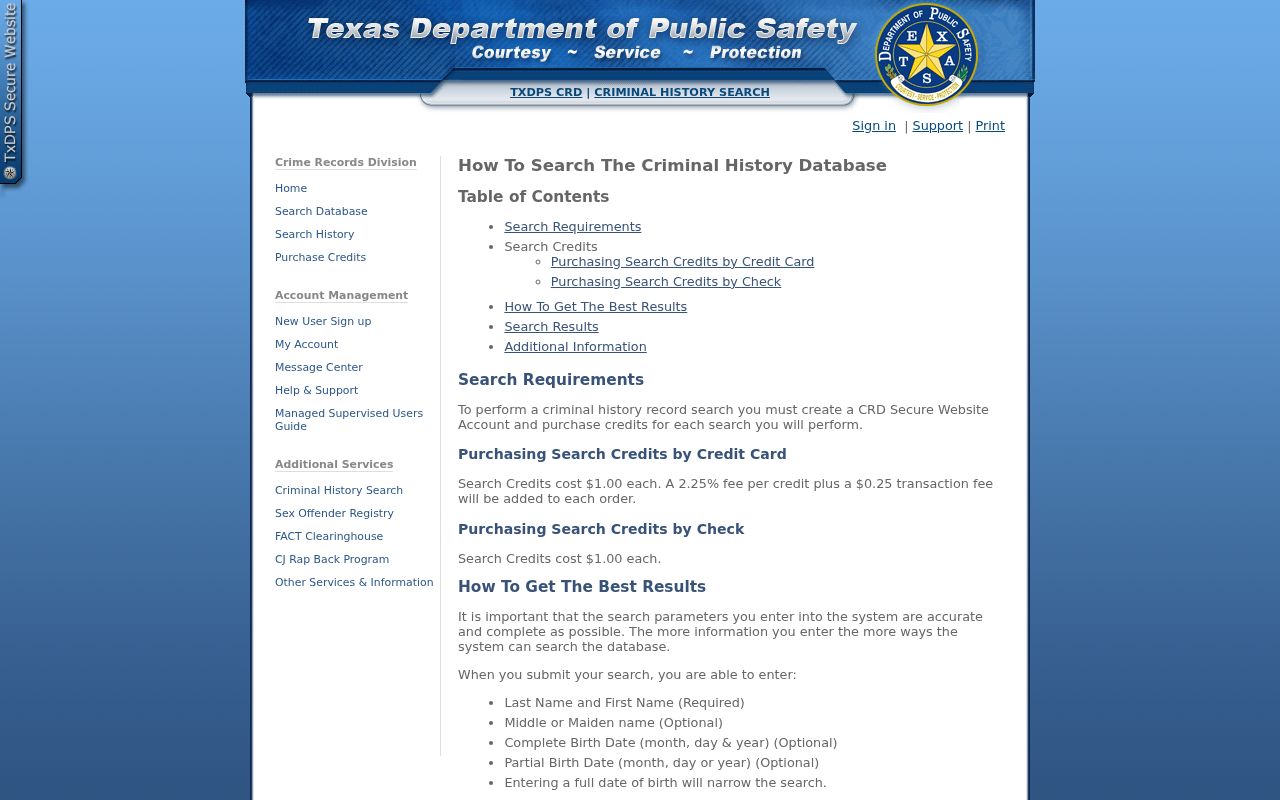
This name product is useful for public statewide data, but it does not replace the Cameron County clerk file or a fingerprint self-review.
| Item | Published amount |
|---|---|
| DPS search credit | $1 each |
| Credit-card addition | 2.25% per credit |
| Credit-card transaction fee | $0.25 |
| FAST fingerprint service | Depends on service code |
The IdentoGO appointment entry point provides live Texas FAST site and appointment choices.
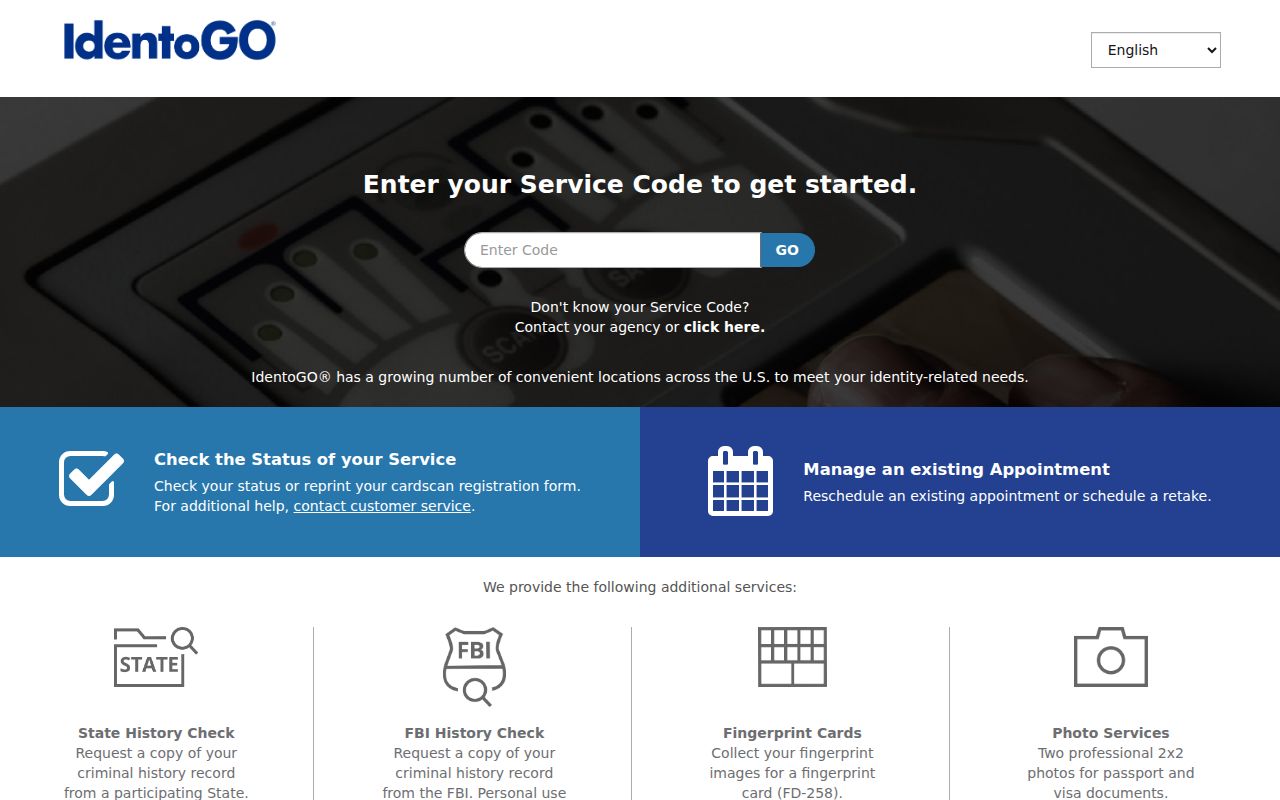
Keep the appointment and transaction reference so a Cameron County record correction can be tracked against the fingerprint result.
Criminal Record Types
Each Cameron County criminal record has a different maker and purpose. An officer writes the incident or arrest report. A jail creates the booking row and custody file. A prosecutor and court create the charge and case docket. DPS links reported fingerprint arrests with later dispositions. A warrant comes from a court and is executed or tracked by law enforcement.
That split explains why one search can be current while another has no result. The records are related, not interchangeable.
- Arrest and booking records: show the event, intake, booked charge, and custody status, not guilt.
- Court case files: show filed charges, settings, motions, pleas, judgment, sentence, and appeal events.
- DPS criminal history: compiles reported arrest and disposition cycles, with a narrower public name product.
- Warrants and capias records: arise from a court, but sealed or unexecuted process may not be public.
- Custody and supervision records: are split among Cameron County jail, CSCD, TDCJ, parole, and federal systems.
Cameron County Booking Record Flow
An arresting officer starts the local trail. If the person is taken into custody, the booking agency assigns identifiers, takes fingerprints and a photograph, lists booked charges, and creates bond or release data. Fingerprint-supported reportable arrests move to DPS. The prosecutor may decline, amend, or replace the initial charge. The clerk then records the case and final result.
Record flow: Arrest report › Cameron County booking › charging decision › court case › disposition report to DPS.
The Cameron County Criminal District Attorney page represents the charging office between arrest and court disposition.
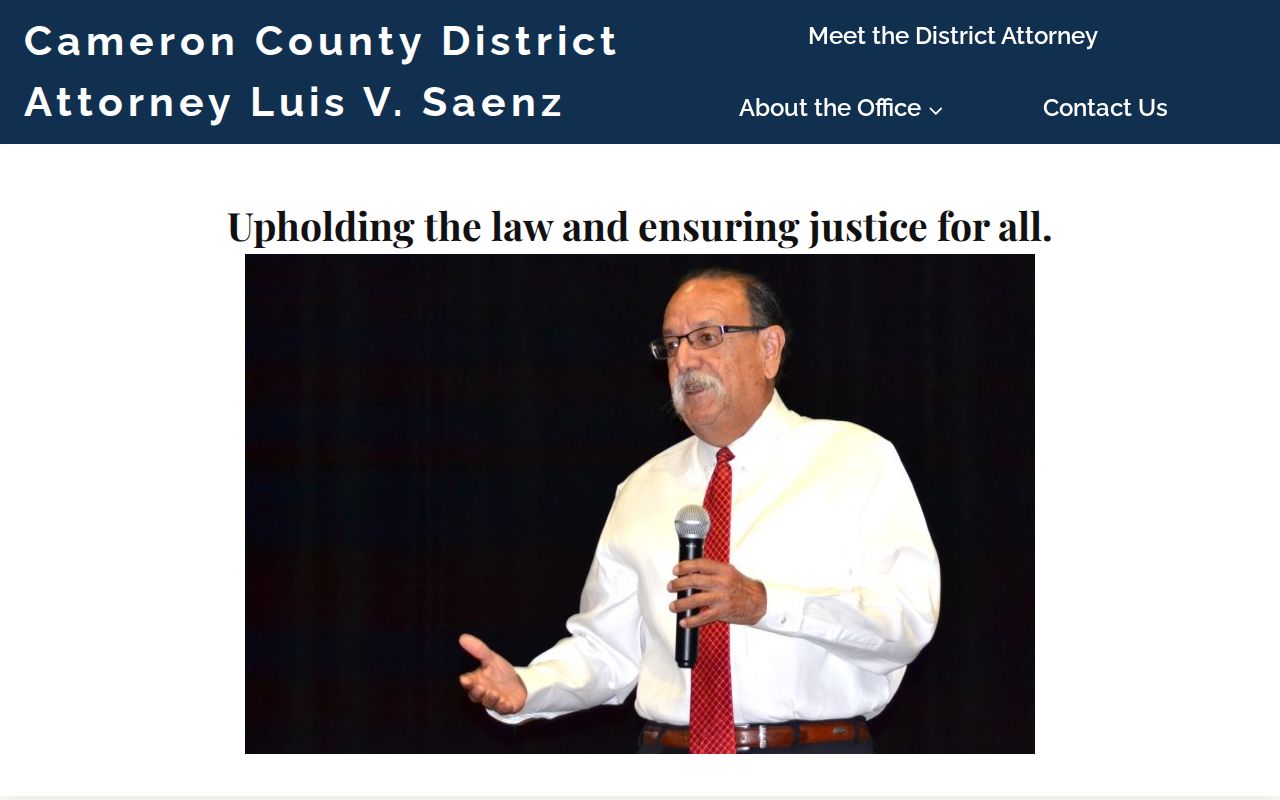
A jail charge may therefore differ from the charge filed in a Cameron County court without either record being false.
Note: A booking proves that custody was recorded, while the clerk's judgment shows how the filed Cameron County charge ended.
Inside a Cameron County Criminal Record
A Cameron County court record may show a cause number, filing date, case status, charge text, statute, offense degree, bond, hearings, attorneys, docket events, disposition, sentence, costs, and appeal activity. A DPS history may add aliases, a state identification number, arrest agency, fingerprint transaction identifiers, and linked prosecution data. The jail row is much narrower and centers on intake and custody.
| Name and identifiers | Names, aliases, date of birth, SID or FBI number where assigned and lawful to display |
|---|---|
| Arrest and booking | Agency, date, booked charge, booking number, SO number, bond or release details when available |
| Filed case | Court, cause number, filing date, filed statute, charge class, settings and docket events |
| Disposition | Dismissal, acquittal, deferred adjudication, conviction, plea, judgment date, or other recorded outcome |
| Sentence | Jail or prison term, fine, costs, restitution, or community supervision when public |
| Limits | Victim data, minors, personal identifiers, sealed filings, and protected records may be redacted or withheld |
- Disposition
- The recorded result of a charge or case.
- Deferred adjudication
- Community supervision while a finding of guilt is deferred; it is not an ordinary dismissal.
- Capias
- A court writ directing that a person be taken into custody.
- SID
- The Texas state identification number tied to fingerprint-supported criminal-history data.
Cameron County Federal Record Layer
Brownsville is also a federal division seat. A Cameron County search can therefore miss a federal prosecution even when the event occurred nearby. The U.S. District Court for the Southern District of Texas, Brownsville Division, sits at 600 E. Harrison Street. Federal docket sheets and filed documents are searched through PACER, while federal custody after sentencing belongs in the Bureau of Prisons locator.
The official PACER system shown below is the records route when a Cameron County court search does not cover a federal case.
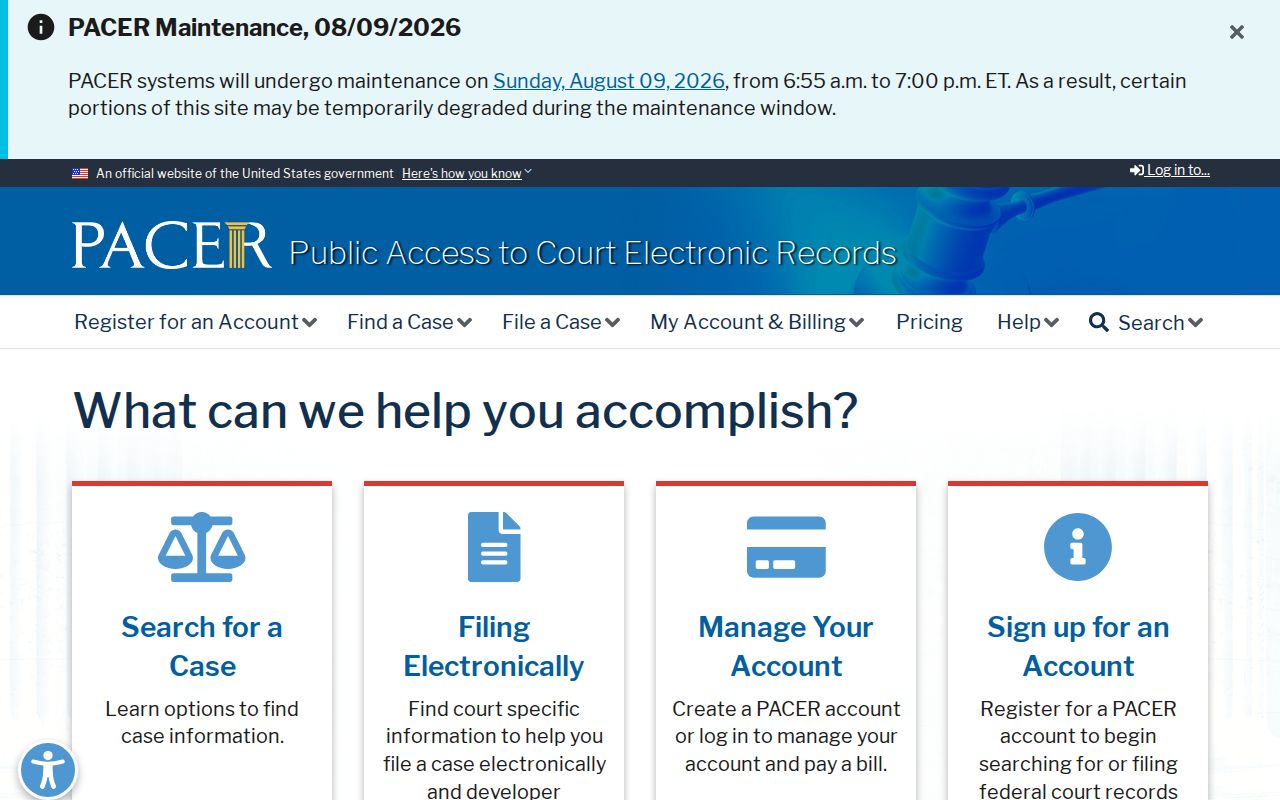
PACER requires an account and may charge for pages. The county clerks cannot certify a Southern District judgment.
For a subject-only federal identity review, the FBI electronic Identity History Summary portal begins the fingerprint request.
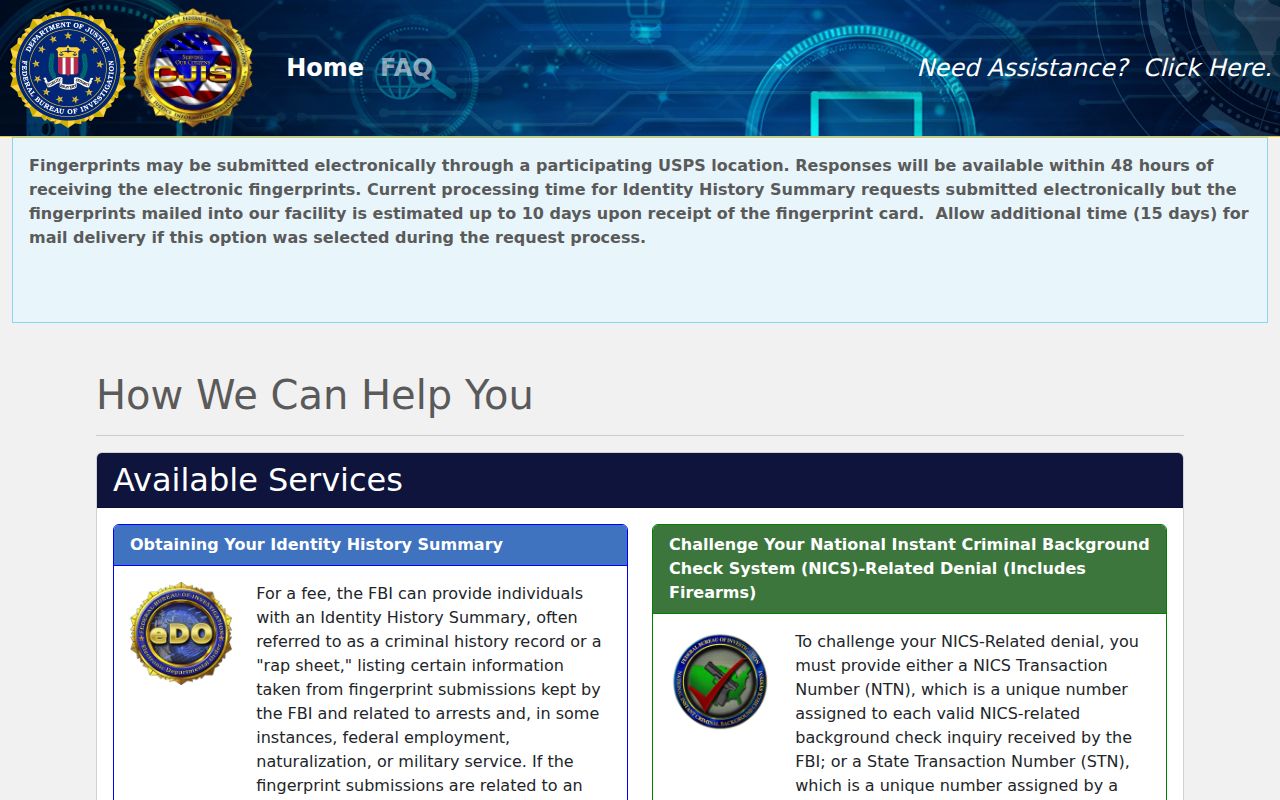
The FBI summary has a different scope from both PACER and Cameron County criminal court records.
Public Access Laws in Texas
Texas law uses different access rules for agency records and judicial files. Police, sheriff, and district-attorney requests generally run through the Texas Public Information Act. Court records are obtained from the proper clerk under the judiciary's access framework. Public criminal-history information from DPS has its own statutory scope. Public access does not mean that protected data may be rebuilt or used to harass someone.
Key Texas laws:
Government Code Chapter 552 sets public access, law-enforcement exceptions, and the Attorney General review process.
Government Code Section 411.135 authorizes DPS public criminal-history access within its statutory limits.
Code of Criminal Procedure Chapter 55A controls eligibility and procedure for Texas expunction.
Code of Criminal Procedure Chapter 62 governs registry information, verification, and duration.
Requesting Cameron County Criminal Records
When no database has the needed document, send a narrow request to the office that holds it. For a police or sheriff record, give the event date and time, location, involved person, report or booking number if known, arresting unit, and the exact item sought. For a court file, give the cause number, court, parties, document name, and date range. Asking a sheriff for “all criminal history” can delay routing because the sheriff does not own the statewide DPS compilation or the complete court file.
The Cameron County DA public-information form accepts detailed written requests at dapir@co.cameron.tx.us. Its ten-business-day language describes the TPIA response process, not a promise that every record will arrive within ten days. Broad requests may require clarification, a cost estimate, a deposit, or an Attorney General decision.
Access path: Sheriff or city police for an incident record › court clerk for the filed case and certified judgment › DPS for public statewide history › FAST for your fingerprint self-review.
Sealed, Expunged, and Restricted Records
Texas expunction and nondisclosure are separate remedies. Chapter 55A expunction can require qualifying arrest records to be returned or destroyed. A Government Code Chapter 411 nondisclosure order restricts public dissemination but still permits access by listed criminal-justice and government entities. Neither remedy should be promised from a short facts summary because eligibility turns on the arrest, charge, disposition, waiting rules, and exceptions.
Cameron County searches may also omit juvenile material, victim and minor identities, active-investigation details, sealed documents, financial identifiers, and other confidential data. A blank result can mean the wrong court, a reporting lag, a spelling mismatch, restricted status, or no responsive public record. After an order, keep certified copies and compare the county portal with a personal DPS review so stale data can be raised with the reporting custodian.
Cameron County Warrants and Supervision
Cameron County has no verified public countywide sheriff warrant search. The inmate roster is not a warrant list. Confirm a district-court warrant or capias with the issuing court, District Clerk, and Sheriff. Check Class A or B misdemeanor process with the County Clerk or Court at Law. Municipal and justice courts handle citation warrants and capias pro fine within their jurisdiction. Sealed warrants and active-investigation material may not be public.
A safe personal resolution starts with the issuing court, then case, bond, or appearance instructions. Cameron-Willacy Counties CSCD supervises local community-supervision cases, while the TDCJ Parole Division handles state parole field supervision. The Cameron-Willacy CSCD office at 854 E. Harrison Street in Brownsville can clarify its own supervision process, but day-to-day files are not offered through one public probation search. An old judgment alone does not prove that supervision remains active.
Note: Verify a warrant through the issuing court before acting, since a payment portal or old docket event may not show current status.
Cameron County Criminal Records by City
City police reports and municipal dockets add a local layer to Cameron County criminal records. Brownsville and Harlingen offer online request or court-search routes, while San Benito relies more on its police records contacts and municipal court counter. After a city arrest moves into county custody or becomes a Class A/B misdemeanor or felony case, the record shifts to the Cameron County jail and county clerk system.
Brownsville Criminal Records
192,957 residents · JustFOIA, municipal case search, and short-term city custody channels
Harlingen Criminal Records
72,467 residents · GovQA records center, municipal portal, and city jail contacts
San Benito Criminal Records
24,980 residents · named police records contacts and municipal court counter
Cameron County Criminal Record Context
Records geography reflects Cameron County's border setting. Brownsville is the county seat and also a federal division center, so local and federal files can sit just blocks apart under different custodians. The historic Oscar C. Dancy Building dates to 1912-13 and was restored and rededicated in 2006, but the right modern destination still depends on the record type. The current clerk complex, detention facilities, city police departments, and federal courthouse each answer a different part of a search.
Census estimates for Cameron County and its three largest cities place the county at 433,946 residents as of July 1, 2025, with 89.2 percent identifying as Hispanic or Latino. Spanish-language access is practical here. The jail publishes English and Spanish instructions, and a person who needs language help for a court event should ask the court about interpreter services. For broad agency-report context, the official FBI Crime Data Explorer is distinct from a personal criminal-record search. Local history adds context, but it never changes the need to verify a current Cameron County record with the office that created it.